| |  |
|
A COLLECTION OF BARBED WIRE
Some forward looking men realized that, with America's movement westward, people would settle in places when there would be insufficient wood and rocks available to build the enclosures needed to control vast herds of livestock. They realized that alternatives were needed and that the alternatives would have to be cheap and long-lasting.
It appears that several guys were inspired almost simultaneously! In 1867 at least three individuals (Alphonso Dabb, William Hunt, and Lucien Smith) applied for patents on their new fangled idea that became commonly called "bobbed wire" (barbed wire). By 1880 several hundred variations had been patented. Of course, just as soon as the barbed wire became a successful product, numerous small manufacturers began to violate the patents by making and selling (usually only locally) their unauthorized "knock-off" versions of some of the most popular lines. Some copied existing products but added their own special feature or design so that they actually were manufacturing a different product. Over a century later collectors often disagree over whether a particular piece of wire should be identified as the work of the original patent holder or one of the "knock-off" manufacturers.
Farms across America eventually enclosed pastures with barbed wire. Even though the farms have disappeared in many areas, collectors often can still find traces of the barbed wire fencing where a single fence post still stands, or the wire was attached to a tree that still stands. Collectors able to say with certainty that a particular piece of wire in their collection came from the "Old Bradford Place" or "The White Mountain Dairy Farm" or "The Pearce Homestead" have truly preserved an unusual part of their local history. A lucky few can claim "This came from my Great Grandfather's farm."
While this collection was born out of a Murray County man's curiosity, those who want to truly delve into this unusual subject should seek out a copy of what many consider the definitive book on the subject: The Bobbed Wire Bible, by Jack Glover, published by Cow Puddle Press, Sunset Texas. The book is an excellent illustrated guide that contains more than 1,000 excellent drawings, each showing the detail of a particular type of wire. Perhaps the easiest way to locate this book is to use a free online book finder service: http://www.mxbf.com. Type in the title and/or author, and this service searches for both new and used copies from thousands of retailers, then ranks them according to price—usually in less than a second! Come to think of it, using today's new fangled computer technology to find a book about something considered new fangled in the 1870s is a bit amusing in itself.
ABOUT THIS COLLECTION
This collection belongs to Herman McDaniel, who graduated from Murray County High School in 1955 - - back when farming was still a way of life in Murray County, Georgia.
He initially is providing pictures and brief information about only 96 variations of wire - - he said that this stuff is hard to photograph, claiming that he has a problem getting all the pieces in a picture to smile at the same time! But he promises that he will add pictures and information about other barbed wires until he has posted his entire collection of several hundred different types. His collection even includes pieces of barbed wire the Nazis used to encircle their concentration camps in the 1930s and 1940s in Germany.
BARBED WIRE COLLECTION
Tap Specific Image To Go To Collection!
 |
Collection 1 |
 |
Collection 2 |
 |
Collection 3 |
 |
Collection 4 |
 |
Collection 5 |
 |
Collection 6 |
 |
Collection 7 |
 |
Collection 8 |
 |
Collection 9 |
 |
Collection 10 |
 |
Collection 11 |
 |
Collection 12 |
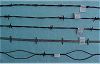 |
Collection 13 |
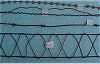 |
Collection 14 |
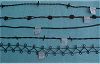 |
Collection 15 |
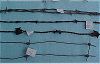 |
Collection 16 |
| | |  | |


